“I should probably keep on shooting, but in Russia, many people don’t wear masks. They thought I was some inspector, trying to expose them,” he says. Sometimes, weeks went by without capturing a single moment.
“Nastia Korkia, who is my co-producer, but also my partner, would ask: ‘Did you ‘catch’ anything today?’ I felt like a fisherman, coming home empty-handed. I thought about giving up, but then I would run into someone special again.” Including a Santa Claus and a girl discussing the “vastness” of the Russian soul.
“So many people think I made these conversations up. But I didn’t even speak to them! They were sitting there, eating clementines, talking about everything: Hitler, history, war, space, religion. On New Year’s Eve – can you imagine? They didn’t even ask what I was doing, they didn’t care. Down there, people move in some kind of trance. I could be right in front of them and they wouldn’t see me.”
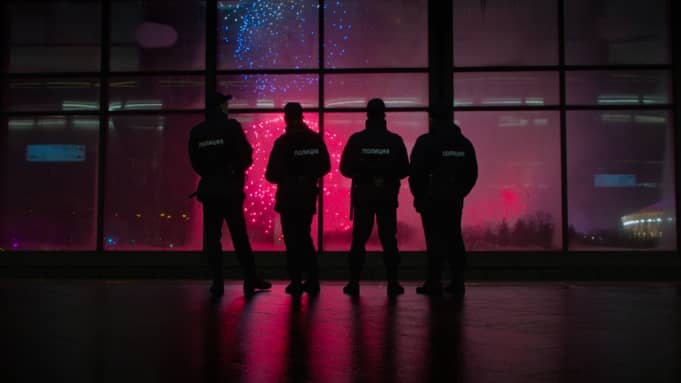
While also depicting protests following the arrest of Alexei Navalny, Fedotow didn’t want to make a political film about the regime, he says.
“People ask me sometimes: ‘Hey man, you are from Belarus, so how come you are showing Russia?’ For me, there is still this connection between our countries. We both have to deal with police government, we face a lot of similar problems – also when it comes to our personal freedom. These protests? That’s our life. It just happens.”
Instead, he decided to portray problematic issues with lightness, fishing for hope wherever he could find it.
“It couldn’t be just about pain and sadness,” he says, crediting Korkia with the film’s absurd humor.
“She would say: ‘It’s a bit dark.’ Now, it’s tragicomic. You feel bad for these people, fooled by the propaganda, but you feel frightened as well. Sometimes, it was hard to find these funny moments, or even love. I don’t know why. Maybe that’s how it is in Moscow? Love lives there, but it’s hard to find it sometimes. Unlike drunk people.”
Fedotow wanted to focus on brief encounters in the film, capture small details, things that happen suddenly and unexpectedly.
“Nastia would ask why I am not following these people until the end. I just wanted to enjoy the moment, that’s it; be this invisible cinematographer dressed in black, doing everything on his own. Let’s take this guy, walking around with a chandelier. For me, he is looking for light, or maybe he can finally bring it to someone else. It’s hopeful for me.”
He did try to reach out to some of his protagonists, however, not that they appreciated the intrusion.
“In the film, I show this one woman, standing next to the statue. She just wouldn’t leave; she kept looking at it. I decided to ask her about it. For myself, not for the film. But she was surprised to see me, didn’t tell me anything and just left. Maybe it’s better not to know. This way, we can just keep on wondering.”
Source:variety